7/12/12

Bishop Against Mass During Pilgrimage


 Our Lady of Gietrzwałd, Ora Pro Nobis

There is a rosary pilgrimage going from Warsaw to Gietrzwałd  between July 12-20 this year. The organizers have requested a permission of the Archbishop of Warmia to celebrate the Mass in extraordinary form in the local parish churches where they are staying during the pilgrimage.

Sanctuary of Our Lady in Gietrzwałd


This is the answer they have received:
I would like to inform you, answering your question dated May 30th 2012, that Archbishop of Warmia do not grand the permission to celebrate the Holy Mass in the extraordinary form of the roman rite during the pilgrimage (4th Rosary Pilgrimage from Warsaw) to Gietrzwałd on the territory of the Archdiocesies of Warmia (in Nidzica, Olsztynek and Gietrzwałd).

Archbishop is opposed (against) to celebrat the Mass in the extraordinary form, where it was not celebrated (sic) till now and local parishioners (faithful) did not ask for that form of the Holy Mass.

Archbishop is happy that pilgrims go to Gietrzwałd along the parishes of the Archdioceses of Warmia.

Olsztyn, July 6th 2012
Bishop Jacek Jezierski


UPDATE. July 16th, Bishop has changed his mind. Deo Gratias 

7/11/12

Ecclesia Militans

'Where are they?'

Beware of Polish bishops. They might be serious catholic!

Votive Garb Of The Precious Blood

 The Roman Ritual provides one more devotion associated with the Most Precious Blood: 'Votive Garb'. If you know anything more about this devotion, feel free to share it with us.

All we read in the ritual is that the vestment should be black and be wear by person who want to honor the Precious Blood and obtain 'well-being in body and mind. Help her to worship you in true faith as the Creator of all things; strengthen her hope in your only-begotten Son, Redeemer of the world; help her to love you above all else as the supreme good and to keep your holy commandments, until it becomes her happy lot to attain everlasting glory'.


BENEDICTIO VESTIS VOTIVÆ
PRETIOSI SANGUINIS
Vestis votiva nigra adhibetur.
V. Adjutórium nostrum in nómine Dómini.
R. Qui fecit cælum et terram.
V. Redemísti nos, Dómine, in Sánguine tuo.
R. Et fecísti nos Deo nostro regnum.
V. Te ergo quæsumus, tuis fámulis súbveni.
R. Quos pretióso Sánguine redemísti.
V. Dómine, exáudi oratiónem meam.
R. Et clamor meus ad te véniat.
V. Dóminus vobíscum.
R. Et cum spíritu tuo.
BLESSING OF A VOTIVE GARB OF THE
PRECIOUS BLOOD
This garb is black in color.
V. Our help is in the name of the Lord.
R. Who made heaven and earth.
V. You have redeemed us, Lord, in your blood.
R. You have made us to reign with our God.
V. We therefore implore you to save your servants.
R. Whom your precious blood has redeemed.
V. O Lord, hear my prayer.
R. And let my cry come unto Thee.
V. The Lord be with you.
R. And with thy spirit.
Orémus.                                                                                             Oratio
Dómine sancte, Pater omnípotens, ætérne Deus, a quo descéndit omne bonum, et omne donum: tibi grátias reférimus pro suscéptis votis, et per mérita pretiosíssimi Sánguinis dilécti Fílii tui Dómini nostri Jesu Christi, ac per intercessiónem beatíssimæ Vírginis Maríæ præsta fámulæ tuæ, quæ hanc vestem indúerit, salútem mentis et córporis; ut te Creatórem ómnium recta fide colat, et in Fílium tuum Unigénitum, Redemptórem mundi, spem suam confírmet, teque summum bonum super ómnia díligat, ac sanctis mandátis tuis semper obédiat, donec ad ætérnam glóriam felíciter perducátur. Per eúmdem Christum Dóminum nostrum. R. Amen.
 Et aspergatur aqua benedicta.


Let us pray.                                                                       Prayer
Holy Lord, almighty Father, everlasting God, from whom every good and every gift descends on us, we offer you our thanks for having heard our prayers. By the merits of the precious blood of your beloved Son, our Lord Jesus Christ, and by the prayers of the blessed Virgin Mary, bestow on your servant who is to wear this garment well-being in body and mind. Help her to worship you in true faith as the Creator of all things; strengthen her hope in your only-begotten Son, Redeemer of the world; help her to love you above all else as the supreme good and to keep your holy commandments, until it becomes her happy lot to attain everlasting glory; through Christ our Lord. R. Amen.
It is sprinkled with holy water.

7/9/12

Cord And Sash Of The Precious Blood

 
Another sacramental that is connected with the devotion to the Precious Blood of Our Lord that our Mother, Holy Church gives us is the red cord or sash of the Precious Blood.

The Roman Ritual gives the following blessing:


BENEDICTIO FUNICULORUM ET VITTARUM
PRETIOSI SANGUINIS

Vittæ fiunt ex lana rubei coloris, quæ, si exterius a mulieribus ferantur, a sinistro latere pendent. Funiculi pariter ex lana rubea conficiuntur.

V. Adjutórium nostrum in nómine Dómini.
R. Qui fecit cælum et terram.

V. Redemísti nos, Dómine, in Sánguine tuo.
R. Et fecísti nos Deo nostro regnum.

V. Te ergo quæsumus, tuis fámulis súbveni.
R. Quos pretióso Sánguine redemísti.

V. Dómine, exáudi oratiónem meam.
R. Et clamor meus ad te véniat.

V. Dóminus vobíscum.
R. Et cum spíritu tuo.
BLESSING OF CORDS AND SASHES OF THE PRECIOUS BLOOD

The sashes are made of wool dyed red; and if they are worn outwardly by women they ought to hang on the left. The cords too are made of wool dyed red.

V. Our help is in the name of the Lord.
R. Who made heaven and earth.

V. You have redeemed us, Lord, in your blood.
R. You have made us to reign with our God.

V. We therefore implore you to save your servants.
R. Whom your precious blood has redeemed.

V. O Lord, hear my prayer.
R. And let my cry come unto Thee.

V. The Lord be with you.
R. And with thy spirit.

Orémus.                                                                                             Oratio
Omnípotens sempitérne Deus, qui Unigénitum Fílium tuum constituísti humáni géneris Redemptórem, ac ejus Sánguine placári voluísti: da nobis tuæ dilectiónis augméntum, et super hos funículos (vel super has vittas) bene + dictiónem tuam infúndere dignáre; ut, quicumque eis cinctus fúerit, suórum delictórum contritiónem in terris habére mereátur, et ab omni carnis labe, cunctísque perículis mentis et córporis liberátus, ad vitam pervéniat ætérnam. Per eúmdem Christum Dóminum nostrum. R. Amen.
 Et aspergantur aqua benedicta.
Let us pray.                                                                       Prayer
Almighty everlasting God, who appointed your only-begotten Son the Redeemer of the human race, and willed to be appeased by His blood; increase our love of you, and be pleased to pour out your blessing + on these cords (or sashes). Let him (her) who is to be girt with one know compunction for his (her) sins in this life, be delivered from every sin of the flesh and all dangers to body and soul, and finally attain everlasting life; through Christ our Lord. R. Amen.
 They are sprinkled with holy water.

I have also found the following thoughts on this sacramental:
 Cord of the Precious Blood is a pious and efficacious practice recommended particularly to the sick.
 To glorify the Precious Blood of our Divine Redeemer and draw down its salutary benediction, is to wear the red cord blessed in its honor.

7/8/12

Archconfraternity and Scapular of the Most Precious Blood

In the month of July dedicated to the Most Precious Blood, let us have a look on the devotions related to the Price of our Salvation.

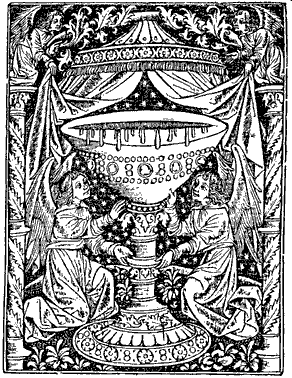
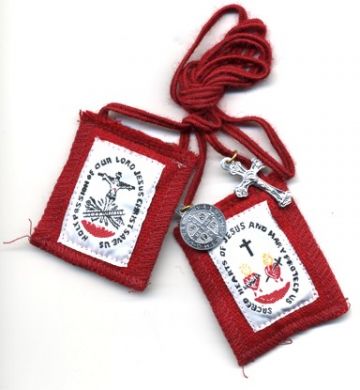
Red Scapular of the Most Precious Blood is associated with the Confraternity of the Precious Blood. It is made of red cloth and carries the representation of the chalice with the Precious Blood adored by angels on one piece while the back portion is a solid piece of red cloth. The faithful who wish to join the Confraternity of the Precious Blood need only have their scapular blessed by a priest to become invested.

No special indulgences, however, are connected with the wearing of this scapular, and the wearing of it is left optional to the members of the confraternity. For the scapular it is prescribed only that it be of red cloth. The scapular as used in Rome bears on one portion a representation of the chalice with the Precious Blood adored by angels; the other segment which hangs at the back is simply a smaller portion of red cloth.


 Red Scapular of the Passion, similar to the scapular of the Most Precious Blood


BENEDICTIO SCAPULARIS PRETIOSI SANGUINIS
Scapulare fieri solet ex lana rubei coloris cum imagine Ssmi Crucifixi, vel Ssmi Cordis D. N. J. C. Sanguinem manantis super Calicem.
Suscepturus Scapulare genuflectit; et Sacerdos, superpelliceo ac stola rubea indutus, dicit:
V. Adjutórium nostrum in nómine Dómini.
R. Qui fecit cælum et terram.
V. Redemísti nos, Dómine, in Sánguine tuo.
R. Et fecísti nos Deo nostro regnum.
V. Te ergo quæsumus, tuis fámulis súbveni.
R. Quos pretióso Sánguine redemísti
V. Dómine, exáudi oratiónem meam.
R. Et clamor meus ad te véniat
V. Dóminus vobíscum.
R. Et cum spíritu tuo
BLESSING OF THE SCAPULAR OF THE PRECIOUS BLOOD
This scapular should be made of wool dyed red, and it should have on it an image of the crucifixion or one of our Lord’s Sacred Heart with blood flowing into a chalice.
The one who is to receive the scapular is kneeling. The priest, vested in surplice and red stole, says:
V. Our help is in the name of the Lord.
R. Who made heaven and earth.
V. You have redeemed us, Lord, in your blood.
R. You have made us to reign with our God.
V. We therefore implore you to save your servants.
R. Whom your precious blood has redeemed.
V. Lord, heed my prayer.
R. And let my cry be heard by you.
 V. The Lord be with you.
R. And with thy spirit.
Orémus.                                                                                             Oratio
Ætérne Pater, et omnípotens Deus, qui Unigénitum tuum vestem nostræ mortalitátis indúere, et Sánguinem suum pretiósum pro mundi salúte effúndere voluísti: obsecrámus cleméntiam tuam, ut hoc genus vestiménti quod in signum devotiónis fidélium erga salútis nostræ prétium institútum est, bene + dícere, et sancti + ficáre dignéris; ut, quicúmque eo usus fúerit, indúere mereátur eúmdem Dóminum nostrum Jesum Christum Fílium tuum: Qui tecum vivit et regnat in unitáte Spíritus Sancti Deus, per ómnia sæcula sæculórum. R. Amen.
Et aspergatur aqua benedicta.
Let us pray.                                                                       Prayer
Almighty God and everlasting Father, who willed that your only-begotten Son be clothed in our mortal nature, and shed His precious blood for the salvation of the world; we humbly beg you in your boundless goodness to bless + and to hallow + this garment, designed as a sign of the faithful’s devotion to the price of our redemption. Let him (her), who is to wear it, deserve likewise to put on this same Lord Jesus Christ, your Son, who lives and reigns with you, in the unity of the Holy Spirit, God, forever and ever. R. Amen.
 It is sprinkled with holy water.

7/7/12

Mass in Dominican Rite Back to Krakow!

 Asperges

 Prayers at the foot of the altar
S. In nómine Patris, ☩ et Fílii, et Spíritus Sancti. Amen.
S. Confitemini Domino quoniam bonus.
M. Quoniam in saeculum misericordia ejus. 
S. Confiteor Deo omnipotenti, et beatae Mariae semper virgine, et beato Dominico patri nostro, et omnibus sanctis, et vobis, fratres, quia peccavi nimis, cogitatione, locutione, opere et omissione, mea culpa;
precor vos orare pro me.
 

 Gloria in excelsis Deo

Dominus meus et Deus meus

July 1st, 2012 Feast of the Most Precious Blood of Our Lord Jesus Christ
Church of Saint Giles in Krakow near Wawel

Source: rytdominikanski.pl and more photos

The usual way of concelebration

His train filled the temple

Isaiah 6:1 "In the year that king Uzziah died I saw also the Lord sitting upon a throne, high and lifted up, and his train filled the temple."

1/22/12

Lamb Blessing Ritual on Saint Agnes Day


This is a traditional text of the Lamb Blessing on saint Agnes day by the Pope on January 21st each year. You are invited to translate the main prayer Omnipotens et misericors Deus.

¶ Finita Missa statim Vicarius assistens vadit ad deponendum super credentiam Pluviale, Abbas vero accepta mitra, et facta cum ea debita Cruci reverentia, simul cum Diacono et Subdiacono accedit ad faldistorium, ubi sedit, depositis prius manipulis a Ministris, suumque dimittit, iterum Clerici ponunt super Altare duos Agnos, floribus in capite coronatos, cum pelvino in cornu Evangelii et Epistolæ: Cantores cantant antiphonam sequentem ( Stans, etc.) : In eodem tempore Abbas cum mitra imponit ter incensum in thuribulo de more illud benedicens ; expleta Antiphona mitratus accedit ad altare cum Ministris, et ante ipsum, mitra deposita, facta reverentia Cruci in medium ascendit, ubi manibus iunctis in tono feriali, sive cantu, has præces et orationes dicit.

¶ Postea accipit a Diacono aspersorium, et cum eo ter aspersit Agnum in cornu Evangelii in medio, a dextris, et a sinistris, et alterum in cornu Epistolæ pariter ter eodem modo, ac ter adolet incenso, quo aspersit. Deinde accepta mitra, et facta reverentia Cruci revertitur ad faldistorium ad deponenda paramenta.


Ant. Stans a dextris eius Agnus: nive candidior Christus sibi sponsam et martyrem consecravit.

Ant.


V. Adiutorium nostrum in nomine Domini.
R. Qui fecit coelum et terram.
V. Dominus vobiscum.
R. Et cum spiritu tuo.


Our help is in the name of the Lord
Who made heaven and heart
God be with you 
And with your spirit

OREMUS. Omnipotens et misericors Deus qui per Moysem famulum tuum Pontificibus tabernaculos servientibus, indumenta instituisti: et per sanctos Apostolos tuos Sacerdotibus et Pontificibus Evangelicis vestimenta sacra providisti: effunde tuam sanctam Benedictionem super hos Agnos, de quorum vellere sacra Pallia pro Summis Pontificibus, Patriarchis, et Archiepiscopis conficienda sunt: ut qui eis utuntur una cum plebe sibi commissa per intercessionem B. V. et M. Agnetis (super cuius tumbam oramus) ad æternam benedictionem perducantur: Per Christum Dominum nostrum. Amen.


Let us pray.

OREMUS. Deus qui infirma mundi eligis ut fortia quæque confundas; concede propitius ut qui Beatæ Agnetis Virginis et Martyris tuæ solemnia colimus eius apud te patrocinia sentiamus. Per Dominum nostrum Jesum Christum Filium tuum, qui tecum vivit et regnat in unitate Spiritus Sancti Deus, per omnia sæcula sæculorum. Amen.

Let us pray. God, Who hast chosen the weak things of the world to confound the things which are mighty, mercifully grant unto us that we who keep the solemn feast of thy blessed Virgin and Martyr Agnes, may feel the power of her intercession with thee. Through our Lord Jesus Christ(…). Amen


1/18/12

Usus Antiquior in Mariacki Church


Some Actions and places are simply perfect for each other.

Our Lady Basilica in Krakow

See the most stunnig God's church of Krakow in 3D
Mariacki


1/14/12

Missale S. Ordinis Praedicatorum

Under the link http://bc.dominikanie.pl can be found many interesting old liturgical and spiritual books. The website is in Polish and English, however many books posted are also in German and Latin.

Rare examples:
Missale  S. Ordinis Predicatorum – Ordo Missae on the 131 page
Breviarium juxta ritum Sacri Ordinis Praedicatorum from 1894
Officium hebdomadae sanctae iuxta ritum Sac. Ord. Praedicatorum


1/12/12

Symbolism of Cappa Magna

After my previous post about Cappa Magna I would like to draw more attention to this symbolic vestment that is rarely understood in modern times. First we have to understand that Church communicates using symbols that have inner meaning expressing certain ideas. Without accepting this statement all symbols in the liturgy, objects and other actions will be just esthetic and empty thing.
If we do not accept functions of symbolism, Cappa Magna is funny, meaningless object and it is useless to read next part of this text.
However, if we accept use and function of symbols, we must try to understand it, which would enrich our reality, instead of getting rid of it.
I have found an interesting definition and symbolism of Cappa Magna:

“The Cappa Magna does indeed represent the finery of the world, its power and prestige. That is why after his entrance wearing it, the prelate is publicly stripped of this finery and humbled before the congregation. Then, vestment by vestment, the bishop is clothed in the new man of which St Paul speaks, including the baptismal alba, the dalmatic of charity, the stole of pardon and the chasuble of mercy. When finally clothed in Christ, the prelate makes a second entrance into the church to begin the Eucharistic celebration in persona Christi, the visible head of the body, the church.
It was a clear statement that the power and prestige of the world have no place at the altar, but it is expressed in a liturgical ritual or symbol, which, unfortunately, are often lacking in the contemporary rites and thus hard to grasp”.
  Clear, precise and quite true.


But still, this definition does not convince people to this garment. There must be something more that makes so much noise around that:

“The Cappa Magna may have been appropriate in another age and in another time, but not today. Our bishops are meant to be pastors not princes.”
“It's still the dress of monarchs”
“The cappa magna, regardless of its former intent makes the cleric the point of the liturgies and not the assembly with the sacrament.”
And these are the point why the world hates and will never like Cappa Magna - it represents what actually the Church is: Proud of its traditions and Hierarchical. Cappa Magna is a symbol that opposes to two revolutionary statements:


Liberté – in the Church we are not free, we are voluntarily God’s slaves, slaves of His law, slaves of His Liturgy, slaves of Rubrics. We do not discuss on what people will say, we just follow the rules.

Égalité – in the Church WE ARE NOT EQUAL, in any way. We are Hierarchical. One depends on the other. And Cappa Magna is a sign of jurisdiction. It is worn only by bishops in their own diocese, by abbots in their abbey, by Cardinals all over the World and by Pope (once a year, but still).
Moreover, the Church is monarchical. The Pope is also a King (yes, he is), the Cardinals and bishops are princes of the Church (abbots are Dukes ;-). So the association of Cappa Magna with ‘dress of monarchs’ is pretty accurate. It will not be accepted, because they would rather see Bishops a pastors and not rulers.


Will they like Cappa Magna ever? NO, they will not, in the same way as they will not like hierarchy, monarchy and differences between people. Because they hate all authority, they hate all symbols and superiority of all kind, which Cappa Magna represents.